
About All Tours From Jaipur ToursWildlife Safari ToursPrivate ToursTiger Safari Tours Directions Hours & Fees Guides
Find Tours 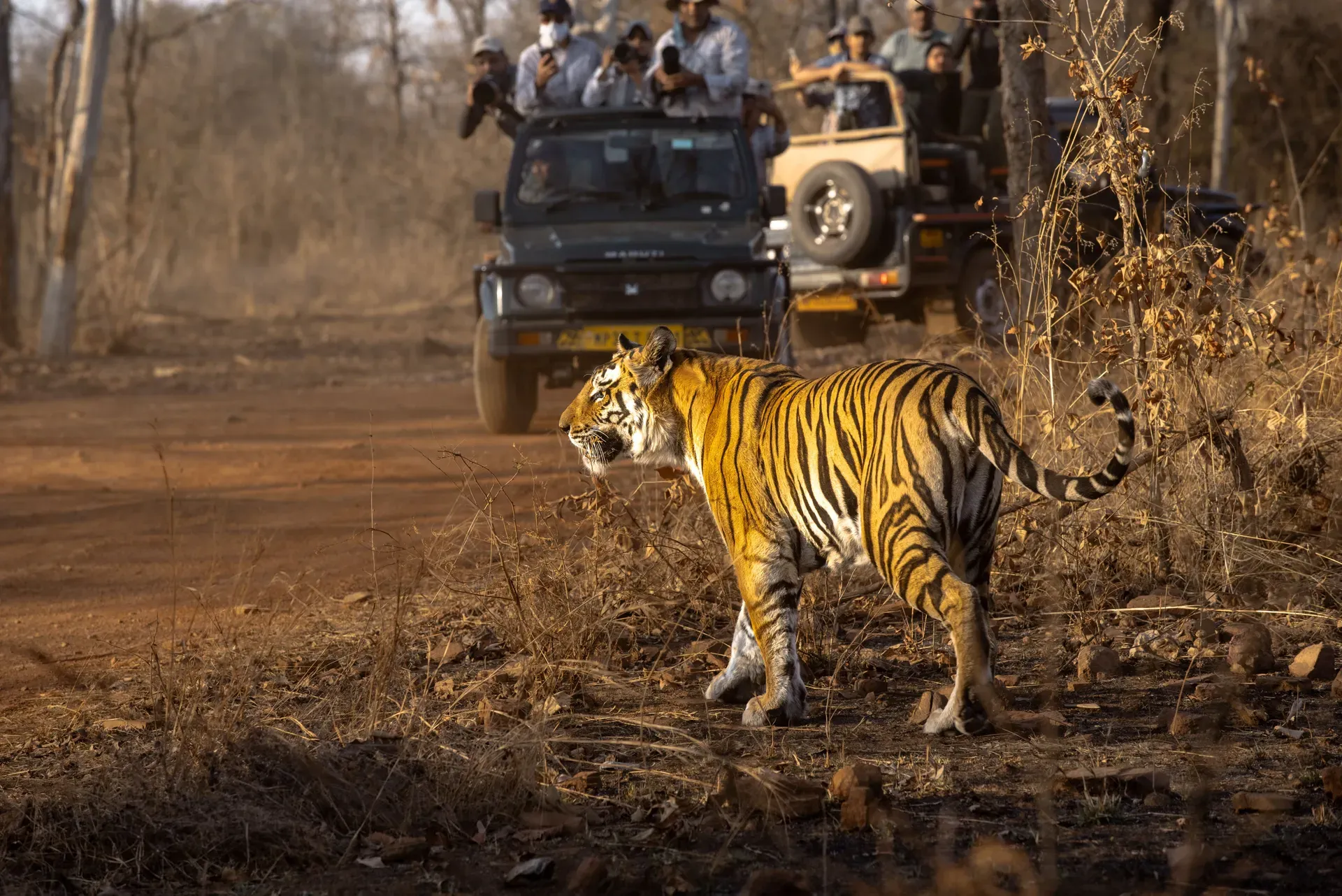
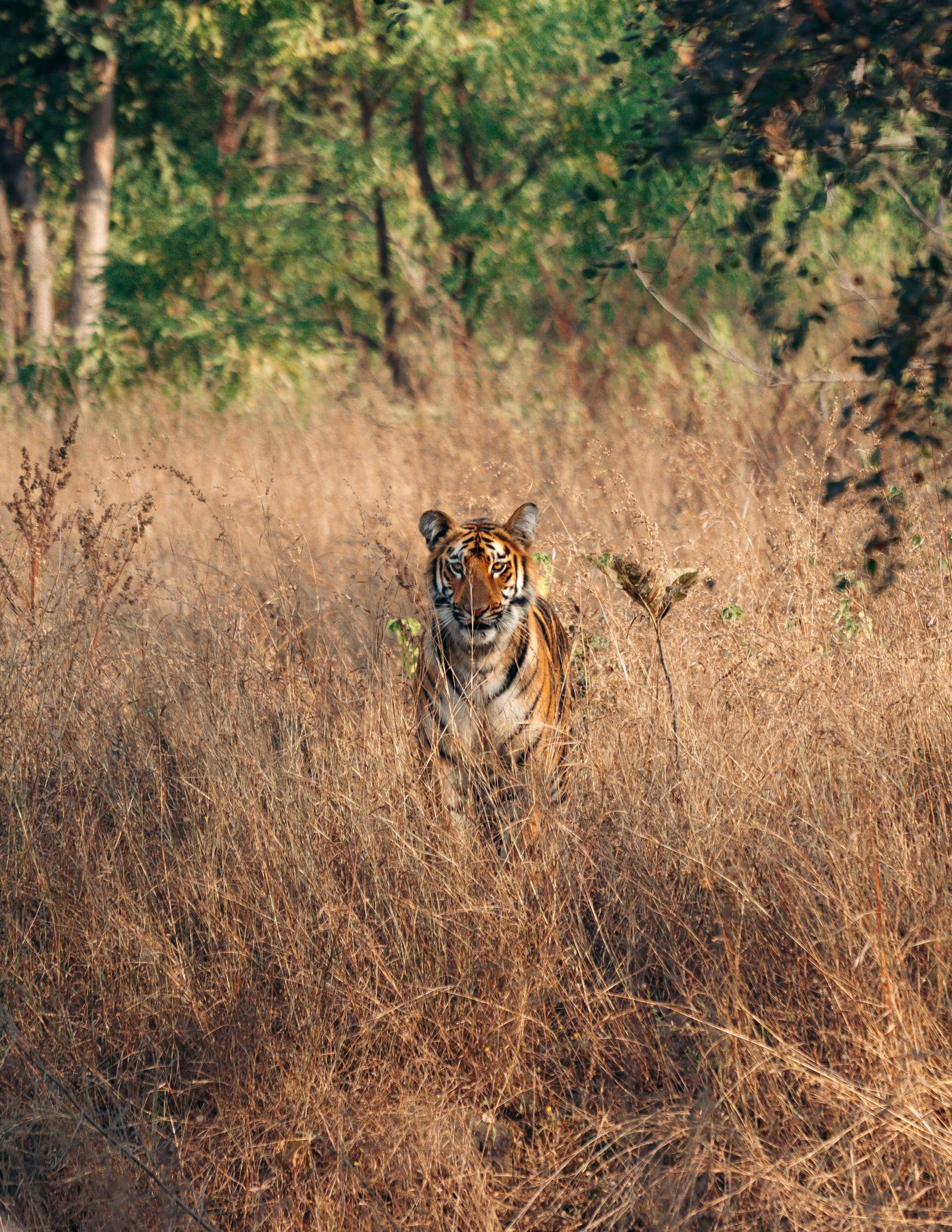
Around 88 wild tigers share 1,334 sq km of dry forest, lakes and ruins with a 10th-century hill fort at Ranthambore National Park, near Sawai Madhopur in Rajasthan, 180 km southeast of Jaipur. Its cats are famously indifferent to safari vehicles, which makes this one of the best places on earth to watch a wild tiger in daylight.
Wild Bengal tigers hunt in daylight here and nap beside the track a jeep-length from your seat, and that's what puts Ranthambore on the map. The park covers 1,334 sq km of Sawai Madhopur district in Rajasthan, roughly 180 km southeast of Jaipur, at the junction of the Aravalli and Vindhyan hill ranges between the Banas and Chambal rivers. Its tigers are so used to vehicles that they sprawl across the dirt tracks and hunt sambar in open view, which makes this one of the few places on earth where a wild tiger photograph owes more to patience than luck.
The habitat is the largest intact stretch of dry deciduous dhok (Anogeissus pendula) forest left in India, broken up by grasslands, rocky ridges and more than a dozen lakes. A 10th-century fort rises 700 ft above the canopy at the centre — it became a UNESCO World Heritage Site in 2013 — and crumbling pavilions stand half-drowned in Rajbagh Lake, so tigers drink among centuries-old ruins. Sambar, leopards, sloth bears, mugger crocodiles and 315 bird species share the ground with them.
The tigers were nearly lost. Poaching cut the population to about 15 animals in the early 2000s; strict protection rebuilt it to 69 by 2022 and roughly 88 by 2024-25. Tourism runs on 3.5-hour game drives in 6-seat Gypsies or 20-seat canters between 1 October and 30 June, with the core closed for the monsoon. Most visitors do 3-4 drives over two or three days. April-June brings the best sightings despite 40°C afternoons, because every animal in the park has to come to the lakes to drink. Book permits through the Rajasthan Forest Department portal as soon as your dates are fixed — they're non-refundable and sell out weeks ahead in season.
Chauhan Rajputs built Ranthambore Fort in the 10th century on a flat hilltop 700 ft above the plain, and the jungle below served whoever held it for the next thousand years. The fort changed hands repeatedly — Rajput clans, the Delhi Sultanate after Alauddin Khalji's long siege of 1301, then the Mughals — before settling under the Kachwaha Maharajas of Jaipur. Inside the walls they left 12th-13th-century Hindu and Jain temples, deep-cut water tanks, and the Trinetra Ganesh shrine that still draws pilgrims today. By the 19th century the forest was the Maharajas' private hunting ground, and they staged tiger shoots from Jogi Mahal, the red-roofed lodge on the shore of Padam Talao.
That era closed in 1955, when 282 sq km of the forest became the Sawai Madhopur Game Sanctuary. In 1973-74 the sanctuary joined Project Tiger among the scheme's founding reserves, and the core was declared a national park in 1980. Two additions followed — the Kailadevi sanctuary to the east and the Sawai Man Singh sanctuary — stretching the tiger reserve to its present 1,411.28 sq km, of which 1,113.36 sq km is core and 297.92 sq km buffer.
The early 2000s nearly finished the tigers off. Poaching dragged the population down to about 15 animals, and India's flagship reserve started reading like a cautionary tale. The response was relentless: stricter patrols, villages relocated out of the core, constant monitoring of every territorial cat. Numbers turned. A census counted 69 tigers in 2022, and by 2024-25 the figure stood near 88, a 25 percent jump in two years. The reserve grew healthy enough to export cats, sending tigers to repopulate Sariska after poachers emptied that park completely.
UNESCO inscribed the fort in 2013 as one of the Hill Forts of Rajasthan, which tied the monument and its jungle together for the outside world. Today the park runs two 3.5-hour game drives a day from 1 October to 30 June, split across ten tourism zones that close on rotation — zones 1-5 on Wednesdays, zones 6-10 on Tuesdays. The core shuts entirely for the monsoon, 1 July to 30 September, so roads get repaired and breeding animals are left alone. Pilgrims still climb the steep path to the Trinetra Ganesh temple, past gates the Chauhans built. A valuation of the reserve's ecosystem put its annual benefit flow at 8.3 billion rupees. Protection, it turns out, pays better than shooting ever did.
The reserve sits where the Aravalli and Vindhyan ranges collide, bounded by the Banas River to the north and the Chambal to the south, with the land rising from 215 m to 505 m. Dhok (Anogeissus pendula) is the backbone of the habitat — a tough dry-deciduous tree that grips the rocky ridges in low, gnarled stands — and more than 300 tree species grow here in total, over 100 of them with medicinal uses. Ecologically the park belongs to the Khathiar-Gir dry deciduous forest ecoregion, the same family of forests that shelters Gujarat's lions. Grasslands and scrub break up the tree cover in between.
Water shapes everything. More than a dozen lakes and streams thread through the forest, and Padam Talao is the largest, fringed by water lilies and the red-roofed Jogi Mahal, with one of India's largest banyan trees growing beside the lodge. Zone 3 holds the Rajbagh complex, where crumbling pavilions, arches and stepped baths stand half-drowned in water and strangler figs — egrets stalk the flooded lawns, and tigers cross between the old stones. That ruin-meets-wildlife scene has anchored more tiger documentaries than any other single view in India.
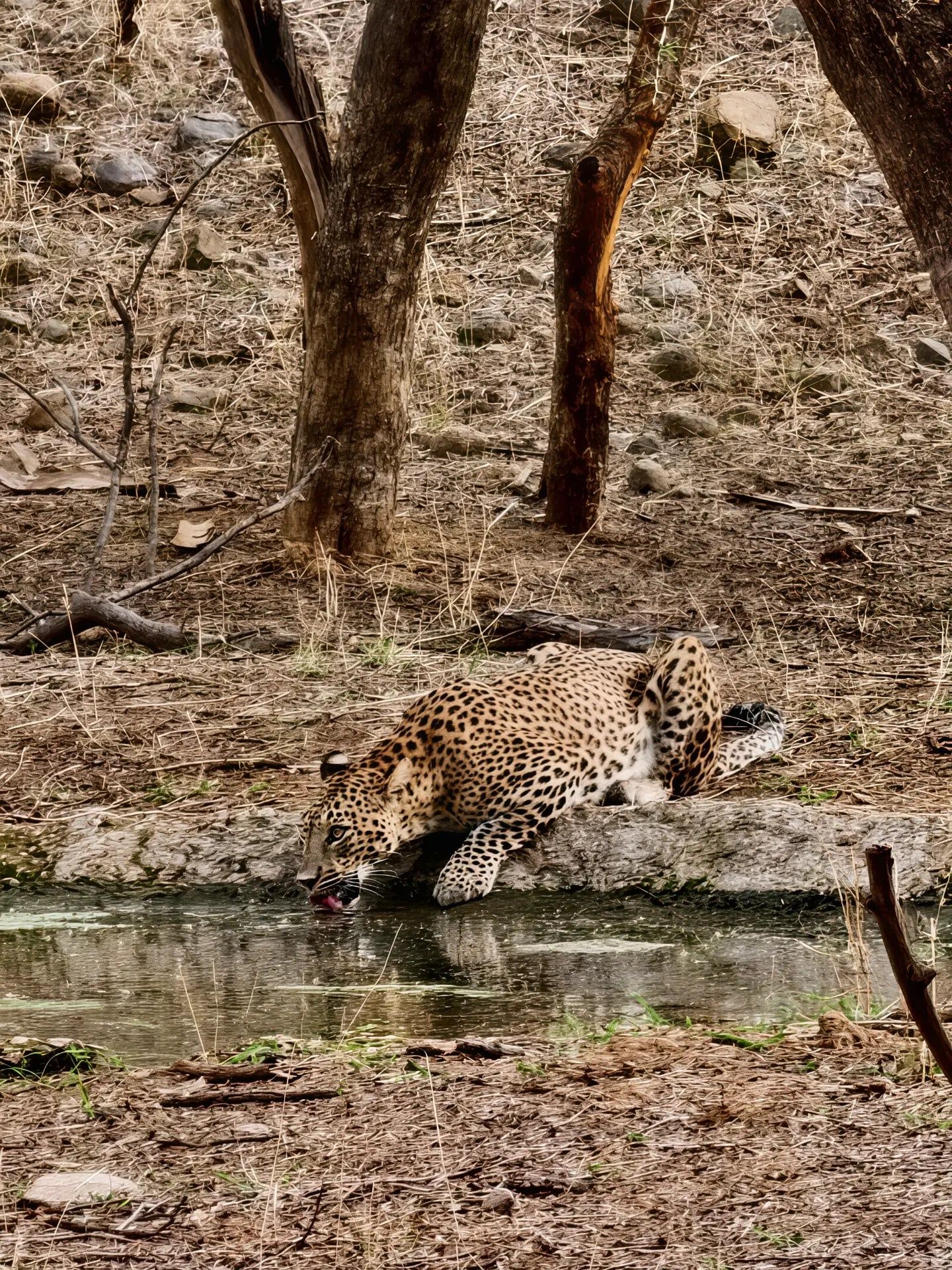
The animal ledger runs to 38 mammal species, 315 birds, 11 reptiles and 10 fish. Leopards and sloth bears favour the rocky Kachida Valley and the Anantpura-Bhakola tracts of Zone 4 and the buffer, along with striped hyena, caracal and jackal — early drives in these quieter zones regularly find leopards on the outcrops. Painted storks and herons work the shallows of Padam Talao at dawn while sambar drink, crested serpent eagles hunt from bare trees, and winter migrants stack the lake margins. In April and June the grass dries down and visibility goes up, which is why photographers accept the 43°C afternoons.
Religious life centres on the Trinetra Ganesh temple inside the fort, counted among the oldest Ganesh shrines in India. Families across Rajasthan mail the first invitation of a wedding to Ganesha here — wedding cards reach the temple by the sackful, delivered in bundles by the postal service. Ganesh Chaturthi each August-September brings thousands of pilgrims up the steep path past the old Chauhan gates. Modest dress covering shoulders and legs is expected at both the temple and the fort.
The park's most famous resident wasn't a king but a tigress. Machli — the name means "fish," after the fish-shaped mark on her cheek — held the Rajbagh and Padam Talao territory in Zones 3 and 4 for nearly two decades, killed a full-grown mugger crocodile in a filmed 2003 fight, and died in August 2016 aged around 19. She was probably the most photographed wild tiger that has ever lived; her obituaries ran in newspapers worldwide, and her descendants still fish the lakes she made famous.
Sawai Madhopur, the rail town at the gates, lives off the park. The Dastkar Ranthambore crafts centre employs women from villages relocated out of the reserve, who block-print and tie-dye fabrics sold direct to visitors, so the money lands in the buffer-zone communities that tolerate leopards on their land. Drivers, guides and lodge staff across the district earn their living from a forest that stays full of cats. Most of them will tell you the tiger saved the town, and the town returns the favour.
In 2003 the tigress Machli killed a full-grown mugger crocodile at the lake edge, a fight caught on film and watched around the world. She lived to around 19, an extraordinary age for a wild tiger.
Rajasthani families send the first wedding invitation to the Trinetra Ganesh temple inside the fort. Postal staff deliver the cards in bulk, and temple staff read them aloud to the deity.
One of India's largest banyan trees grows beside the Jogi Mahal rest house at Padam Talao, its canopy shading much of the lake shore.
Since 1 February 2026, mobile phones are banned on core-zone safaris — no calls, no photos, no video, and the rule covers drivers and guides too. Bring a standalone camera.
After poachers wiped out every tiger in Sariska, cats trucked in from Ranthambore starting in 2008 rebuilt that park's population from scratch.
More than 100 of the reserve's 300-plus tree species have recorded medicinal uses, a fact locals put to work long before the forest became a park.
An ecosystem valuation estimated Ranthambore's annual benefit flow at 8.3 billion rupees — from water retention to tourism to carbon storage.
April to June, despite temperatures of 35-43°C. Drying water holes force tigers and prey to the lakes, and short dry grass makes animals easier to spot. October-November is the comfortable alternative, with green post-monsoon forest and active tigers in mild weather. Avoid July to September entirely — the core park is closed for the monsoon.
A shared 20-seat canter seat runs about INR 1,500 for Indian nationals and INR 3,800-4,550 for foreigners. A shared 6-seat Gypsy costs roughly INR 2,200-2,500 for Indians and INR 4,500-5,500 for foreigners. The price bundles the park permit, vehicle and mandatory guide; children under 5 ride free on an adult's lap.
Book online through the Rajasthan Forest Department system, via SSO registration at sso.rajasthan.gov.in (linked from forest.rajasthan.gov.in). Each account is capped at six bookings a month, permits are non-refundable and non-transferable, and you must carry the original photo ID used at booking to collect your boarding pass. Registered hotels can also book on your behalf.
Zone 3, which takes in Padam Talao, Rajbagh Lake, Jogi Mahal and High Point, has the best mix of scenery and sighting rates. Zones 2 and 4 run it close — Zone 4 was the territory of the famous tigress Machli and holds leopards and sloth bears too. Zones are allotted randomly at check-in unless you pay a premium-zone surcharge.
No. Private vehicles are barred from park roads in all zones. Everyone travels in forest-registered 6-seat Gypsies or 20-seat open canters with an assigned government guide aboard, boarding at the gate after permit and ID checks.
No. Since 1 February 2026, all mobile phone use in the core tourism zones is banned — calls, photos, video and social media — and the rule applies to drivers and guides too. Phones can be confiscated and offenders removed from the drive without a refund. Leave yours in the lodge safe and carry a camera instead.
Ranthambore is one of India's most reliable tiger reserves, with 69 tigers counted in 2022 and roughly 88 by 2024-25, all habituated to vehicles. Even so, sightings are never guaranteed. Most visitors who do 3-4 drives see at least one tiger; single-safari visitors sometimes don't.
About 180 km from Jaipur — 3-4 hours by road or 2-3 hours by train to Sawai Madhopur station. Delhi is roughly 350-360 km away, with trains on the Delhi-Mumbai trunk line taking 3.5-6 hours. Agra is around 230-240 km, about 4.5-5 hours by road.
Each drive lasts 3 hours 30 minutes, once in the morning and once in the afternoon. Two or three days covering 4-6 drives is the realistic minimum for a good shot at a tiger, since a single safari is a coin toss. Morning drives suit predators and birds; hot afternoons pull tigers to Padam Talao and Rajbagh to drink.
Yes, children of all ages can join, and under-5s ride free on a parent's lap (up to two per Gypsy). All wildlife viewing happens from inside the vehicle, so it's inherently safe — the real challenges are dust, sun and cold mornings. Pack scarves, hats, layers, snacks and water, since there are no facilities inside the reserve.
Browse verified tours with free cancellation and instant confirmation.
Find Tours